Our woodland
Hundreds of years old, the woodland at Kingsmeadows is part of our local history, providing us with a sense of place and connecting us to our natural world.



A strategic wildlife corridor
Kingsmeadows connects woodland to the north, east and south of Peebles, including ancient woodlands at Janet’s Brae. The East Woods are part of Scottish Forestry’s Native Woodland Habitat Network precisely because of this connectivity to the surrounding countryside.
These woods are recognised under Scottish policy as notable habitat of high biodiversity value where woodland cover should be increased to redress habitat fragmentation and prevent further biodiversity loss.



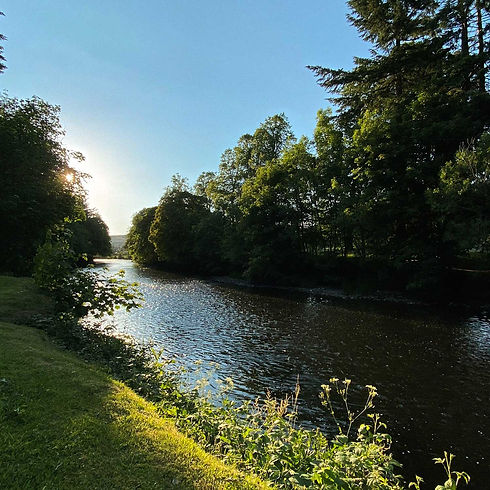
Riparian woodland
Situated on the banks of the Tweed – a designated Site of Special Scientific Interest and Special Area of Conservation – Kingsmeadows lies within a Special Landscape Area and is part of the Scottish Borders Strategic Green Network.
Riparian woodland like this is critical to the health of the river, providing organic nutrients, mitigating extreme flood events and regulating water temperature – something which is essential for survival of species like the Atlantic salmon.
Veteran and notable trees
Ancient and veteran trees are hundreds of years old and of the highest ecological value. They provide essential habitats for many species; oak trees can live for over 1000 years and support 2300+ different species.
Hollow trunks, holes and cavities in these trees provide shelter for wildlife; water pockets around the base are a source of drinking water for many creatures; and rotting dead wood becomes a critical food source that supports complex ecosystems.
See our 10 veteran and 81 notable trees on the Woodland Trust's Ancient Tree Inventory here.


Birds species
Kingsmeadows has 12–14 acres of mixed mature broadleaved native trees and specimen conifers.
This rich habitat supports 51 recorded species of song bird, woodpeckers, wildfowl, corvids, owls and other birds of prey.
Based on UK's BoCC5, 24 of these 51 species are on the Red or Amber Lists – meaning that 47% of the species at Kingsmeadows are endangered and need to be protected.
Mammal species
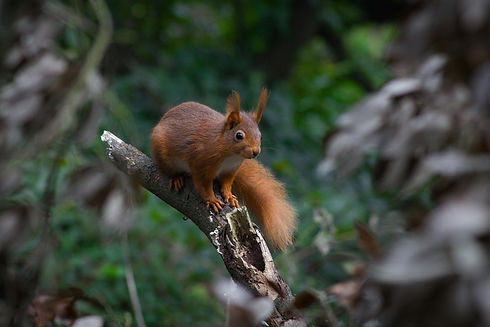
Kingsmeadows provides habitat for a diverse range of mammals, with evidence of badgers, bats, field voles, foxes, hedgehogs, otters, red squirrels, roe deer, stoats, weasels and water voles.
Riparian woodlands like Kingsmeadows make ideal habitat for bats and otters, both European Protected Species. A 2023 bat survey showed evidence of extensive bat activity – preliminary analysis identifying 8 individual species.

Wildflower species
A biodiverse woodland is more than just trees. The understory of flowering shrubs and plants, fungi, mosses, lichens and bryophytes are all critical to the woodland ecosystem, providing wildlife with essential sources of food and shelter.
We have recorded 100 different species of wildflowers, grasses and ferns across different habitats, including several ancient woodland indicator plants – species that signify that a site has been continuously wooded for a very long time.

Kingsmeadows
Ancient Woodland
Among our richest and most biodiverse habitats, ancient woodlands are irreplaceable, with complex ecosystems, undisturbed soils and diverse communities of plants, animals and fungi – including many species simply not found elsewhere.
NatureScot’s expert on Ancient Woodland recently confirmed the status of the woods at Kingsmeadows as Ancient Woodland, based on the evidence of two key historic maps (the 1823 John Wood Map & 1856 1st edition OS map for Peebles) and the presence of 16 species of ancient woodland indicator plants (including dog's mercury, water aven, bluebells and holly, wild garlic).
It is Scottish Government policy to prohibit building on Ancient Woodland and we continue to work to ensure that the woods at Kingsmeadows are preserved for future generations.